FindU
Find Your FitFor CollegesAboutBlog
Sign inGet Started
Home/Blog/How to actually find scholarships (that aren't scams)
Financial Aid

How to actually find scholarships (that aren't scams)

Kenny Morales·March 15, 2026·7 min read
How to actually find scholarships (that aren't scams)

How to actually find scholarships (that aren't scams)

Every year, students miss out on billions of dollars in scholarship money. Not because they don't qualify. Because they don't know where to look, they think they won't get it, or they get overwhelmed and give up.

Let's fix that.

Student searching for scholarships late at night

First: you don't need a 4.0

The biggest myth about scholarships is that they're only for straight-A students or star athletes. That's not even close to true.

There are scholarships for:

  • First-generation college students
  • Students from specific zip codes or counties
  • Left-handed people (seriously)
  • Students who write about a specific topic
  • Kids of employees at certain companies
  • Students going into specific fields
  • People with specific hobbies or backgrounds
  • The weirder and more specific you are, the less competition you have. A national scholarship with 100,000 applicants is way harder to win than a local one with 50.

    Where to actually look

    Start local. This is the biggest thing nobody tells you. The scholarships with the best odds aren't on national websites. They're:
  • From your high school (ask your counselor)
  • From local businesses and Rotary clubs
  • From your parent's employer
  • From community foundations in your county
  • From your church, mosque, temple, or community center
  • These scholarships are usually $500-5,000 and have way fewer applicants. Stack 5-10 of these and you've got a serious dent in your costs.

    Then go school-specific. Every college has their own scholarships. Many are automatic (based on GPA/test scores). Others require a separate application. Check the financial aid page of EVERY school you're applying to. Then go national. These are the big competitive ones:

  • Fastweb
  • Scholarships.com
  • College Board Scholarship Search
  • Your state's education department website
  • Two students discovering scholarship opportunities together

    How to spot a scam

    If a scholarship:

  • Asks you to pay a fee to apply. That's a scam.
  • Guarantees you'll win. That's a scam.
  • Asks for your bank account info. That's a scam.
  • Has no clear organization behind it. Probably a scam.
  • Contacts you out of nowhere saying you've "won". Definitely a scam.
  • Real scholarships never charge application fees. Real scholarships never guarantee money. If it feels off, trust your gut.

    The application game

    Here's a framework that works:

  • Make a list. Every scholarship you find goes on a spreadsheet. Name, amount, deadline, requirements, link.
  • Sort by deadline. Work on whatever's due next.
  • Reuse your essays. Most scholarship essays ask variations of the same 3-4 questions. Write strong base essays and adapt them.
  • Apply to everything you qualify for. Even the $250 ones. It's money you don't have to borrow.
  • Set aside 2-3 hours/week. Treat it like a part-time job. Because at $500/hour of application time, it pays better than any job you'll have in high school.
  • The students who get the most scholarship money aren't the ones with the best grades. They're the ones who applied the most.

    The essays

    Most scholarship essays ask:

  • Tell us about yourself
  • Why do you deserve this scholarship?
  • What are your goals?
  • How will you make a difference?
  • Tips:

  • Be specific. "I want to help people" is weak. "I want to build affordable housing in rural Nebraska because I grew up in a trailer park" is strong.
  • Tell YOUR story. Not what you think they want to hear. The most memorable essays are honest and specific.
  • Answer the question. Read the prompt carefully. Address exactly what they're asking.
  • Proofread. Typos kill applications. Have someone else read it.
  • Student celebrating a scholarship win

    How much time does this actually take?

    If you spend 3 hours a week on scholarships from October to March, that's about 75 hours. If you win $5,000-15,000 in scholarships (very doable), that's $67-200/hour. For context, minimum wage is $7.25/hour.

    There is no other activity in high school that pays this well.

    How FindU helps

    FindU flags scholarships you might qualify for based on your profile. We track deadlines so you don't miss anything. And we show you the real cost of every school after aid, so you can see exactly how much scholarships change the picture.

    The money is out there. You just have to go get it. And make sure you've filed your FAFSA too. That's step zero.


    Keep reading

    Your financial aid offer is trash? Here's how to get a better one

    March 15, 2026·7 min read

    How to pay for college when your family can't help

    March 15, 2026·8 min read

    FAFSA: the form that's standing between you and free money

    March 15, 2026·7 min read

    Your college isn't going to find itself.

    Download App
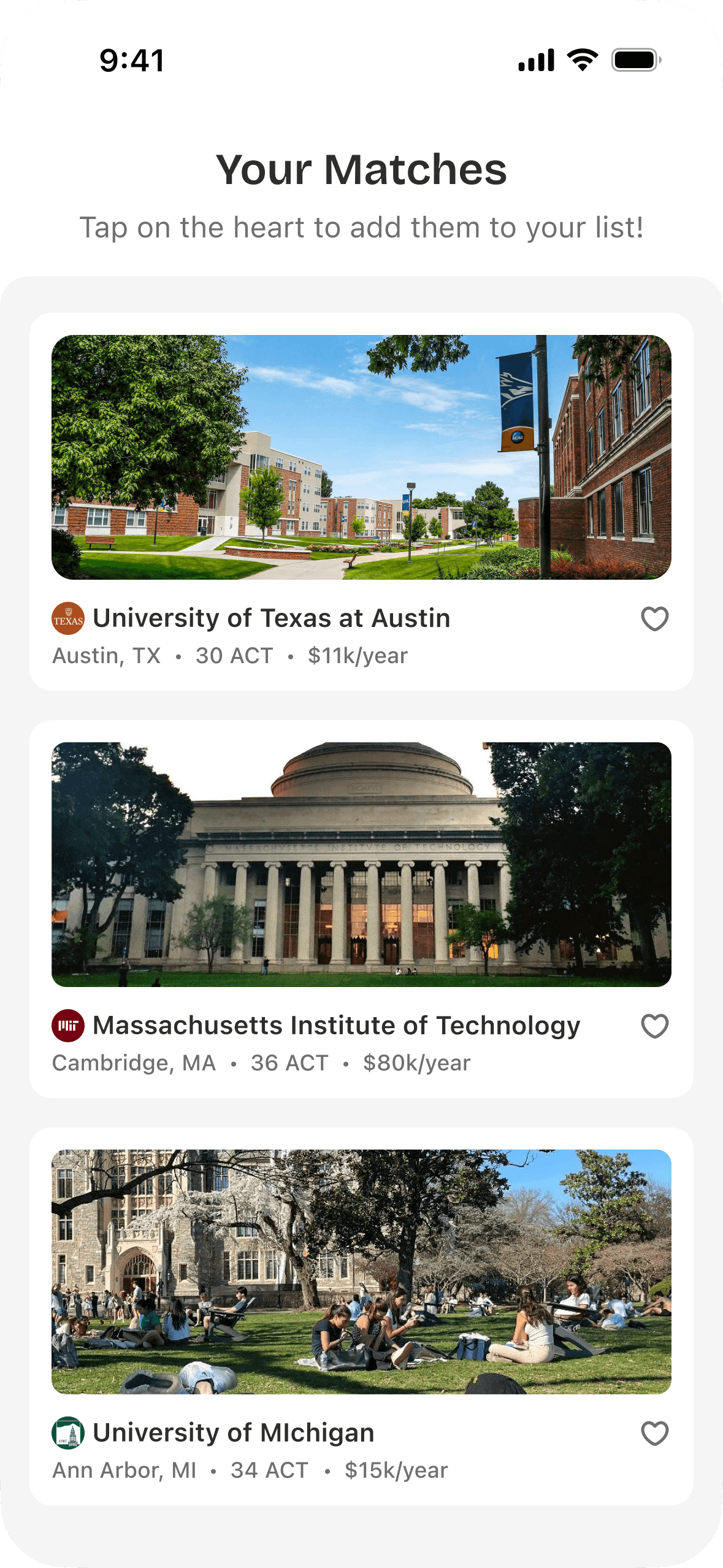
    FindU Your Matches screen
    FindU

    Find Your Fit

    • Take college quiz
    • Chance Me calculator
    • Scholarship search
    • College Search
    • Browse all tools

    Company

    • About
    • Blog
    • Careers

    For Partners

    • For Colleges
    • For Counselors
    • Contact Us

    Legal

    • Privacy
    • Terms

    Join our newsletter